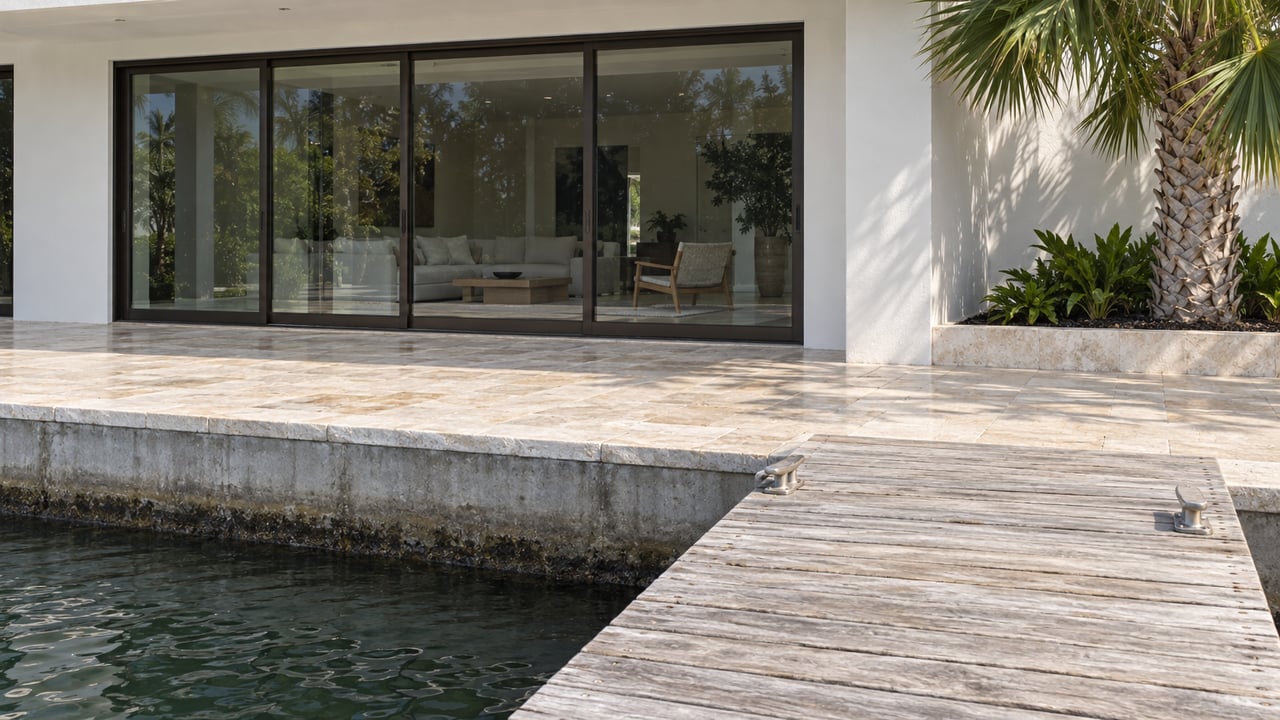
Boat Slip Ownership in North Palm Beach: How Different Arrangements Work
A condo at Paradise Harbour Boulevard in North Palm Beach came on the market not long ago with a 40-by-16 deeded boat slip and a 16,000-pound lift on the Earman River, no fixed bridges between the dock and the Atlantic. The listing carried one line easy to skim past: the slip must be purchased with the unit and cannot be purchased separately. That line is the whole story. It means the slip is not a freestanding piece of real estate the buyer will own the way they own the condo. It is attached to the condo's deed, and it will only ever move with that deed.
A few minutes south, at Soverel Harbour Marina off PGA Boulevard, a buyer can walk into a closing and purchase slip number 27 on its own, with its own deed, its own parcel number, and nothing to do with any residence at all. Same waterway, same boating lifestyle, two completely different legal objects. In North Palm Beach's waterfront market, where a boat slip is one of the deciding factors in a purchase, the phrase "boat slip included" is doing a lot of quiet work, and it does not mean the same thing from one listing to the next.
Florida law recognizes a handful of ways a boat slip can be owned, and the differences matter well beyond the dock.
The cleanest version is a fee-simple slip, most often organized as a dockominium under Florida's condominium statute. Each slip gets its own legal description, its own recorded deed, and its own tax bill, the same as a house. Soverel Harbour's 146 slips, spread across fixed and floating docks from 30 to 75 feet, work this way. A slip there can be bought, financed, insured, and sold as its own transaction, entirely apart from where the owner lives.
The second version, and the one buyers trip over most often, is the limited common element. Here the slip is not its own parcel. It is a right of use tied to a specific condo unit's declaration, the way a parking space is sometimes tied to a unit in a high-rise. The Paradise Harbour listing is a textbook example. The slip transfers automatically when the condo transfers, and it cannot be sold, financed, or insured on its own, because on paper it is not a separate piece of property.
The third version is a lease or license, where the marina or association retains ownership and the boater is really buying the remaining term of a use agreement. These arrangements show up most often where a marina sits on submerged land the state still owns.
Title insurers treat these three differently for a reason. A fee-simple slip or a dockominium unit can carry its own owner's title policy. A limited common element slip is insured only as part of the unit it belongs to, and coverage for the slip right depends entirely on what the recorded declaration says. A license or lease cannot be insured as title to land at all, because there is no land interest to insure.
North Palm Beach's own waterfront market makes this easy to see up close. Old Port Cove sits on a 60-acre Intracoastal peninsula, built out between 1971 and 1982, with eight high-rise buildings, a full-service marina, a yacht club, and condo prices that have ranged from roughly $200,000 for a one-bedroom with pool views to more than $1.4 million for a three-bedroom with panoramic Intracoastal and ocean views. Many of those condos come with a slip, and in most cases that slip is a limited common element attached to the unit's deed, not a separately deeded asset.
Contrast that with a listing not far away at Jonathans Landing, where a unit on Treasure Cove Circle came with a deeded slip rated for a 50-foot boat and a 14,000-pound lift. The word "deeded" there is doing real legal work. It signals the slip has its own conveyance, not just an assigned right that travels along with the condo by default.
Buyers comparing these properties side by side are not comparing two versions of the same amenity. They are comparing two different categories of ownership that happen to look identical from a boat show floor.
| Structure | How it's conveyed | Title insurance | Typical financing | Can it be sold alone? |
|---|---|---|---|---|
| Fee-simple / dockominium | Recorded warranty deed, own parcel number | Separate owner's policy available | Specialty marine lenders, cash common | Yes |
| Limited common element | Tied to the unit's condo declaration | Insured only as part of the unit | Usually rolled into the residential mortgage | No, moves with the unit |
| Lease or license | Assignment with association or marina consent | Not insurable as title to land | Cash or personal loan | Only by assignment, with consent |
A dockominium slip purchased as its own transaction runs into a lending market that is much thinner than the one for houses and condos. Most conventional mortgage lenders will not write a loan against a slip alone. The buyers who finance one typically work with a small pool of specialty marine lenders, and those lenders tend to ask for far more money down than a residential mortgage would, often structured on shorter terms than a typical thirty-year loan. A buyer who assumes slip financing will look like their condo financing is in for a surprise partway through underwriting.
Limited common element slips sidestep that problem in one direction and create a different one in the other. Because the slip is legally part of the condo, its value is usually just folded into the residential mortgage on the unit, with no separate loan to arrange. The tradeoff shows up later, at resale, when the owner realizes the slip was never a separate asset to begin with. It cannot be sold to a boater who wants dockage but not the condo above it, and it cannot be left out of a sale to a buyer who wants the condo but already owns a boat elsewhere.
Property taxes follow the same split. A fee-simple or dockominium slip gets its own tax bill, assessed on its own value and never eligible for homestead treatment. A limited common element slip has no separate bill at all. Its value is baked into the assessment of the unit it belongs to.
The listing sheet will rarely spell out which category a slip falls into. The declaration and the deed will. Before removing contingencies on a North Palm Beach waterfront property with a slip attached, it is worth getting the following in writing, not just described by whoever is selling:
None of these questions show up on a walkthrough. They show up in the declaration, the survey, and the title commitment, which is exactly why they are worth asking before an offer becomes a contract rather than after.
Can one mortgage cover both the condo and the slip? If the slip is a limited common element, yes, because it is legally part of the unit. If it is a separately deeded dockominium slip, the residential lender usually will not include it, and financing has to be arranged separately, if it is financed at all.
Does the slip come with its own tax bill? Only if it is a fee-simple or dockominium slip with its own parcel number. A limited common element slip is taxed as part of the condo unit, with no separate bill.
Can I lease out my slip if I'm not using it? That depends entirely on the governing documents. Some marinas and associations allow it freely, others restrict leasing to owners in good standing, and a lease or license slip may require the original grantor's consent before it can be assigned at all.
Waterfront buyers in North Palm Beach spend a lot of time evaluating bridge clearance, dock depth, and how far a slip sits from open water. Those questions matter. So does the one written into the declaration, because it decides whether the slip is an asset the buyer actually owns or a right that came along for the ride.
If you're weighing a North Palm Beach property with a slip attached and want someone to read the declaration before you write the offer, reach out to Matt & Kate Shaw. We'll walk through what the documents actually say before you're the one finding out at the closing table.
This article is general information, not legal, tax or financial advice. Consult a qualified professional about your situation.
Dedicated to delivering personalized, concierge-style service with impeccable attention to detail.
Get in Touch With Our Team to Learn More
MATT & KATE SHAW
ADDRESS 4658 Northlake BLVD STE 103 PALM BEACH GARDENS FL 33418